Legacy website modernization

IIS website migration, without the emergency.

Legacy IIS, classic ASP, and SQL Server websites moved to modern cloud hosting — planned carefully, tested before go-live, and cut over with zero downtime. Fixed price. No retainers.

The situation

The site still works. That's the trap.

The server is out of support

Windows Server 2012 and 2016 no longer receive the security patches a public-facing website depends on. Every month it runs, the exposure grows quietly.

The developer is gone

Whoever built the site retired, moved on, or can't be reached. There's no documentation, and nobody currently on hand wants to touch it.

The business still depends on it

Orders, forms, and customers still flow through that site every day. You can't afford a botched migration — so nothing gets migrated at all.

Services

Three ways to move an IIS site to the cloud

Every legacy site fits one of three paths. The consultation determines which — and you get one fixed quote for it.

Path 01

Rehost

Same site, safer home.

Your existing website moves as-is to modern cloud hosting. Nothing about how it looks or works changes — it just stops living on a server that's out of support.

Best fit: the site does its job well and just needs to get off dying hardware.

Technical details
  • IIS site lifted to Azure App Service (Windows); classic ASP and ASP.NET supported
  • SQL Server database migrated to Azure SQL Database or SQL Managed Instance
  • Connection strings, app settings, and IIS config translated and verified
  • TLS certificates provisioned; DNS cutover with a final data sync at go-live

Path 02

Rebuild

Same job, modern engine.

The site is rebuilt on a current, supported platform — keeping the content, data, and workflows that work, and shedding twenty years of accumulated duct tape.

Best fit: the site matters to the business but the code has become unmaintainable.

Technical details
  • Classic ASP / ASP.NET WebForms rebuilt on ASP.NET Core on Azure App Service
  • Database schema and data migrated to Azure SQL; queries updated and tested
  • Existing URLs preserved or 301-redirected so search rankings carry over
  • Old and new run side by side until you approve the switch

Path 03

Replace

A clean start, nothing lost.

If the site is really just pages and a contact form, it's replaced with a fast, modern static site. No servers, no patching, and hosting costs near zero.

Best fit: content-only sites where the database and server were always overkill.

Technical details
  • Static HTML/CSS/JS on Netlify or Azure Static Web Apps — no OS to maintain
  • Contact forms handled by the hosting platform; no backend required
  • Legacy database content exported, archived, and handed to you
  • Old URLs mapped with redirects; TLS and global CDN included by the platform

Process

How a zero-downtime migration works

Three phases. Your existing site keeps running, untouched, through all of them.

PHASE 1

Blueprint

We establish what you have, what it should become, and exactly what it will cost. No work starts without a fixed quote you've approved.

See the steps
  1. 01ConsultationA free 30-minute conversation about the site, the server, and what you need.
  2. 02Fixed QuoteOne number for the whole project, in writing. That number doesn't move.
  3. 03Access & Data PullCredentials gathered, site and database copied. Your live site is never modified.

PHASE 2

The Build

The new environment is built and your site migrated to it — in parallel, at a private staging address, while the old site keeps serving customers.

See the steps
  1. 04Build & MigrateCloud environment stood up; site and data moved and wired together.
  2. 05Check-InsShort, scheduled progress updates. You always know where things stand.

PHASE 3

The Switch

You test the new site yourself and approve it before anything changes. Only then does traffic move — with no gap in service.

See the steps
  1. 06Test & ReviewYou click through the staging site and sign off. Nothing goes live until you do.
  2. 07Zero-Downtime Go LiveDNS cutover with a final data sync. Visitors never see a gap. Documentation handed over.

40 yrs

In Microsoft infrastructure

This is the day job, not a side hustle.

  • //Microsoft Certified Trainer (MCT) — certified to teach this material, not just use it.
  • //Cloud Systems Engineer — currently managing enterprise Microsoft infrastructure daily.
  • //In IT since 1986 — old enough to have deployed the systems being rescued, current enough to know where they should go.
  • //Solo, project-based — you talk to the person doing the work, start to finish.

Ground rules

Four things every project gets

Fixed-price quote

One number before work begins. No hourly meter, no scope-creep invoices.

Test before go-live

You review and approve the new site at a staging address. Nothing switches until you sign off.

Zero-downtime cutover

The old site runs until the new one is verified live. Visitors never see a gap.

Full documentation handover

Everything documented and handed to you. No proprietary lock-in, no mystery systems.

FAQ

Questions owners of legacy sites actually ask

Can you migrate a classic ASP website without rewriting it from scratch?

Often, yes. Many classic ASP websites can be rehosted to modern Windows hosting or Azure App Service with targeted fixes rather than a full rewrite. When a rewrite genuinely is the better path, you get that recommendation up front — with a fixed quote for both options, not a surprise partway through.

My website runs on Windows Server 2012 or 2016. How urgent is a migration?

Windows Server 2012 and 2012 R2 support ended in October 2023. Windows Server 2016 left mainstream support in 2022, with extended support ending January 2027. A site on these servers still works — but it no longer gets the protection a public-facing website needs indefinitely.

It's a plan-now situation, not a panic-now one. Planning while the old server still runs is exactly what makes a zero-downtime migration possible.

What happens when my SQL Server or SQL Server Express version reaches end of life?

The database keeps running, but security patches stop — and compliance or cyber-insurance requirements often stop being met. SQL Server 2012 and 2014 are already past end of support.

The usual fix is migrating to Azure SQL Database or a current SQL Server version. Your schema and data move over, and the application is updated and tested against the new database before anything goes live.

How do you move an IIS site to the cloud without downtime?

The new environment is built and tested in parallel while your existing site keeps running untouched. You approve the new site at a staging address. Go-live is a DNS cutover with a final data sync — visitors are directed to the new site while the old one still answers, so there's no gap. The old server is retired only after the new site is verified in production.

What does an IIS website migration cost?

Every project gets a fixed-price quote after a free consultation and a look at the existing site. The quote is the price — no hourly meters, no change-order surprises for anything in the agreed scope. Ongoing cloud hosting costs are itemized separately and paid by you directly to the provider, so there's no markup and no dependency.

Do I need a monthly retainer or maintenance contract afterward?

No. IIS Rescue is project-based by design. Every project ends with a full documentation handover — hosting details, where credentials live, architecture notes, and how-to steps — so any competent IT provider can maintain the site after handover. No proprietary lock-in, no mystery systems.

What if I no longer have the source code or access to the old server?

This is common and usually solvable. Depending on what still exists, the site can be recovered from the server itself, from hosting-provider backups, or reconstructed from the live site and database. The consultation establishes what access exists before any quote is given, so recovery work is scoped honestly.

Proof

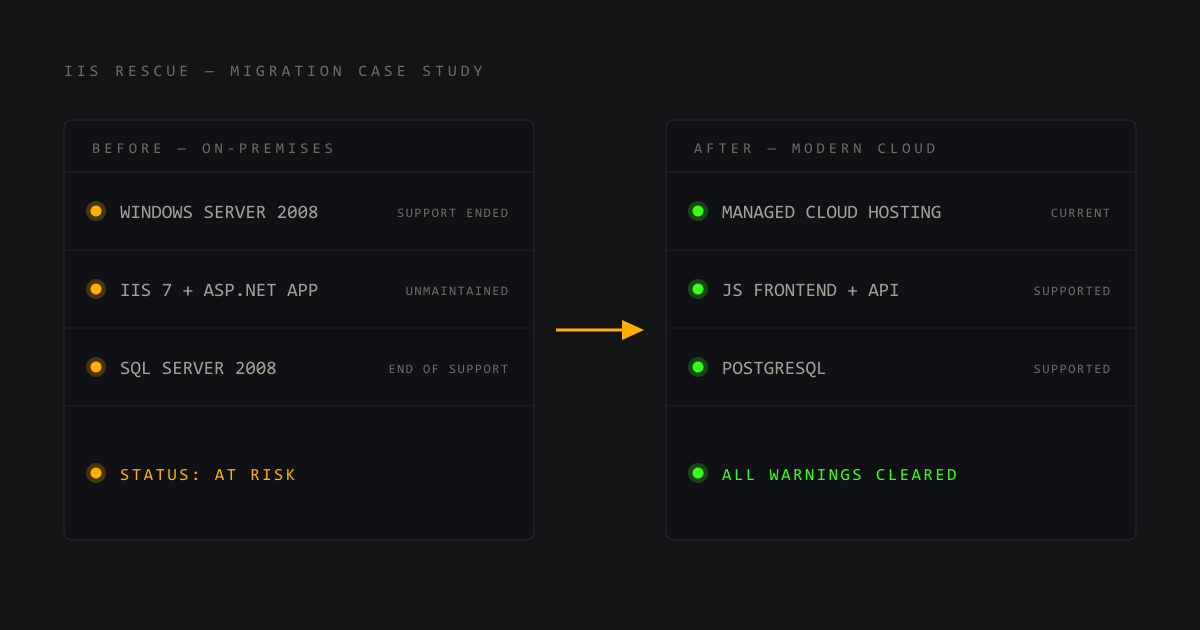
First case study: in progress

Every completed rescue gets written up the same way — the before, the path chosen, and the measured result. The first one lands here soon.

Preview the format

Start with a 30-minute conversation.

Free, no obligation, and you'll leave knowing which of the three paths fits your site — whether you hire me or not.

Book a free consultation